
An Overlooked European Microcap With a Strategic Review Catalyst
Potential Sale Could Unlock 50-100% Upside

Dear readers,
I’m back with a new idea: a micro-cap European electronics manufacturer that has quietly announced a strategic review aimed at selling the company.
The stock trades at just 7x normalized earnings and has compounded book value at 10% annually over the past decade. Despite this, it remains almost entirely under the radar, with little discussion of the stock online.
This company would be highly attractive to a strategic buyer, and in the event of a sale I see 50-100% upside.
Let’s take a look.
Disclaimer: The information provided in this article is for informational purposes only and should not be considered investment advice. Investing involves risk, including the potential loss of principal. The author may own, or plan to purchase, shares in the security discussed. The author is not a registered investment advisor and does not provide personalized investment advice. Always conduct your own research and consider your investment objectives and risk tolerance before making any investment decisions. The author and publisher shall not be liable for any actions taken based on the information provided in this article.
Overview:
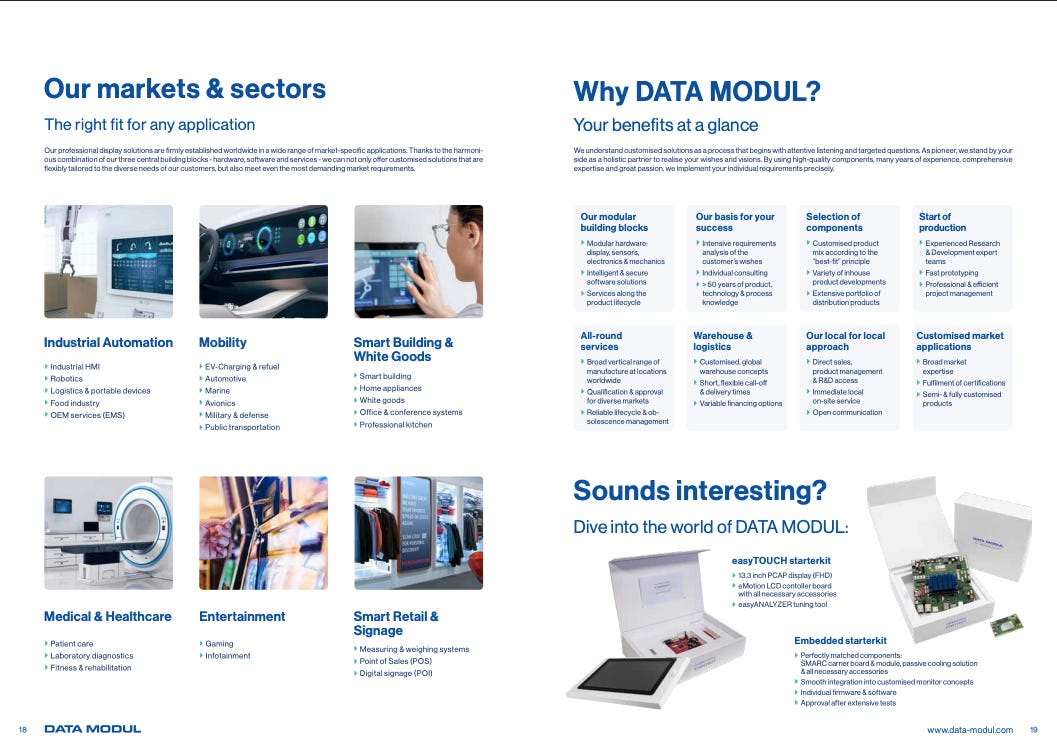
Data Modul AG (DAM.AG) is a German manufacturer of industrial display and embedded computer systems. The company specializes in developing flat panel displays, touch screens, and integrated display systems, serving a wide variety of industries including industrial automation, healthcare devices, marine and avionics, and iGaming.
Data Modul went public on the Frankfurt Stock Exchange in 1988 as a distributor of electronic and display components. It’s most important strategic shift occurred in the early 2000s, when the company shifted operations from distribution into manufacturing through an acquisition. This allowed Data Modul to design and assemble its own display and system solutions, transforming the company from a middleman to a value-add technology partner.
Operating in a competitive industry dominated by much larger global corporations, Data Modul has carved out a niche by focusing on markets too small for large manufacturers. Over the past 20 years, the company has built a strong reputation as the largest European manufacturer of display and touch screen technology, supporting the industrial, medical, and transportation industries worldwide. The company has production facilities in Germany, Poland, China, and the United States.
The company operates in a cyclical industry and can experience substantial fluctuations in revenue and net income. Despite this, Data Modul has been profitable for each of the past 10 years and has compounded book value at 10% annually over the past decade, demonstrating consistent value creation. The company carries no debt and pays a stable dividend.
Ownership:
In 2015, U.S. based Arrow Electronics (ARW), a global technology distributor, acquired a 69% majority stake in Data Modul through a public tender offer at €27.50 per share. Arrow intended to take full control of the company, seeing Data Modul as a strategic fit with its display and embedded systems business.
However, minority shareholders refused to tender enough shares for Arrow to reach the 95% ownership threshold required under German law to initiate a squeeze-out.
As a result, Data Modul has remained publicly listed and operates as an independent subsidiary. While Arrow controls the board, it has taken a largely passive role, with Data Modul continuing its dividend policy and reporting financials separately.
Strategic Review:
Over the past year, Data Modul has struggle due to a variety of factors:
During Covid, many of its customers built up large inventories of display systems to guard against supply chain disruptions. While this resulted in record profitability in 2022-23, orders have since dropped sharply as customers work through existing inventory, resulting in a 20% revenue decline in 2024.
Germany’s manufacturing sector entered a prolonged downturn beginning in 2023, with weak capital spending across many of Data Modul’s key markets.
A stronger Euro has squeezed export margins, as over 50% of Data Modul’s sales are outside Germany.
The company recently notified the market of preliminary 3Q financials: Sales were down 10%, and EBIT was negative for the quarter. On the bright side, their order book grew by 5%, suggesting the cycle may be starting to turn.
The most interesting part of the report is the final sentence, which caught my attention:
“The company has commissioned J.P. Morgan Securities plc to explore strategic options for a re-positioning of the company on the market, which may include the sale of the majority stake in the company by the majority shareholder.”
Notably, this disclosure came from Data Modul itself, not Arrow. However, it is clear that Arrow, as the controlling shareholder, is initiating the process.
Catalyst:
It seems odd that Arrow is looking to sell their stake in the company now, after being content with holding a majority stake for almost a decade. However, after some digging I found a recent event that may have triggered this strategic review.
On October 8th, subsidiaries of Arrow Electronics were sanctioned by the U.S. government due to national security concerns.
This is due to Arrow’s subsidiaries in Hong Kong and China allegedly facilitating purchases of U.S. technology by Iranian proxy groups.
Nowhere does the sanction list name Data Modul, and Arrow has been working with the government to resolve this issue. However, given that Data Modul has a manufacturing facility in China and customers in both China and the Middle East, it is plausible that Arrow prefers to simplify its business and divest operations in regions affected by the sanctions.
For Arrow, Data Modul is small and strategically insignificant with a market cap of €100m and net income <€10m annually. Selling the majority stake would allow Arrow to receive cash while exiting a region with potential regulatory complications.
Although Arrow only owns 69% of Data Modul, it is likely a sale of the majority stake would result in a purchase of the entire company.
Under German Securities law, a buyer acquiring over 30% of a publicly listed company must launch a mandatory tender offer for the remaining shares.
Valuation:
In 2015, Arrow acquired its majority stake at €27.50 per share. Over the past decade, Data Modul has generated €29.3 per share in earnings and nearly tripled its book value.
Yet today you can buy the company for the same price Arrow Electronics paid 10 years ago.
I believe the stock is trading significantly below what it would be worth to a private buyer.
In a normal year, Data Modul generates €15m in net income before taxes. A private equity buyer would likely value the company at 7-10x normalized earnings, or ~€150m, in line with book value, typical for a manufacturing firm with predominantly physical assets. This scenario suggests 50% upside from the current price.
I believe the company could be worth substantially more to a strategic buyer who could use Data Modul to gain market share in Europe and access the company’s OEM relationships.
Such a buyer could pay 12-15x normalized earnings, which would result in 100% upside from todays price.
Even absent a sale, the stock remains attractive, trading at 7x normalized earnings and 0.7x book value, with a history of 10% book value growth and exiting a cyclical downturn.
Stock Reaction:
While the stock is up 20% since the announcement, I believe the market reaction should be stronger. There are a few factors that could explain why the market has not picked up on this information yet:
Small market cap combined with only €30m free float and limited liquidity eliminates most institutions from buying the stock
While the company reports financials in English, preliminary announcements are only published in German. This announcement did not make it onto any mainstream English newswires, and there has been no discussion of the strategic review online.
Data Modul will publish finalized 3Q financials on November 7th, which may serve as a catalyst by bringing more investor attention to the strategic review process.
Risks:
Small and illiquid with low free float
Prolonged downturn in German manufacturing industry
Strategic review concludes without a sale
Overall, this is exactly the kind of setup I look for: a quiet strategic review that could unlock significant upside, with current valuation providing a margin of safety.
If you like reading under the radar ideas such as this, please consider subscribing!
nice write up elias!