
A Microcap Inflection the Market Is Missing
A board overhaul, business divestiture, and improving industry conditions have quietly transformed the company's earnings potential.

Summary:
Activist-led board overhaul aligns incentives with shareholders
Divestiture of cash-burning subsidiary removes major drag on profitability
Operating leverage and improving industry conditions create potential for significant earnings inflection
Some of the best setups in the stock market arise when the past looks nothing like the future.
Investors focus on poor historical performance, but those numbers can quickly become irrelevant when a company fundamentally changes its business.
And by the time the financials reflect that transformation, the opportunity often has already disappeared.
I think today’s stock fits this description.
On the surface, it looks like another struggling microcap with a long history of losses and declining revenue.
But beneath those numbers, the business has quietly undergone a meaningful transformation.
A shareholder-led board overhaul, the sale of an unprofitable subsidiary, and improving industry conditions have materially changed the company’s earnings potential, yet the stock continues to trades near multi-year lows.
The stock is…
Disclaimer: The information provided in this article is for informational purposes only and should not be considered investment advice. Investing involves risk, including the potential loss of principal. The author may own, or plan to purchase, shares in the security discussed. The author is not a registered investment advisor and does not provide personalized investment advice. Always conduct your own research and consider your investment objectives and risk tolerance before making any investment decisions. The author and publisher shall not be liable for any actions taken based on the information provided in this article.
Energy & Environmental Services Inc. (EESE) manufactures specialty chemicals and protective coatings used in the oil and gas industry. Its products help operators reduce friction during drilling, prevent corrosion inside wells, and extend the life of equipment.
The company has a long operating history, being founded in 1989 as Energas Resources before merging with Energy & Environmental Services in 2016. Despite its long history, EESE has largely flown under the radar of investors after moving to the pink sheets in 2011.
At first glance this is not the type of company I typically buy. They operate in a cyclical industry, generate a net loss most years, and have a history of destroying capital through bad acquisitions. But every once in a while the conditions are right for them to generate a lot of cash. There are two main developments that I believe will drive an inflection in the business and lead to significantly higher earnings over the next year:
1. Increase in oil prices and drilling activity
Like many companies of this size, EESE’s results are largely determined by industry conditions rather than internal execution. When drilling activity picks up, EESE benefits from significant operating leverage. Since much of the company’s costs are fixed, even modest increases in revenue can result in a dramatic improvement in profitability.
The company’s historical financials illustrate this well. In a typical year, EESE generates roughly $8-10 million of revenue while producing an operating loss. In 2022 following the spike in oil prices and drilling activity after the conflict in Ukraine, revenue exceeded $20 million and operating income reached $1.7 million.
We may be entering a similar environment today, with rising geopolitical tensions in the Middle East pushing oil prices above $100 per barrel earlier this year. Even if prices moderate from these levels, I believe the disruption has increased the likelihood of sustained upstream investment as producers respond to tighter supply conditions.
One of the best leading indicators of upstream activity are rig counts. A rising number of rigs indicates increased drilling activity and greater utilization of oilfield equipment, which ultimately drives demand for the specialty chemicals EESE supplies.
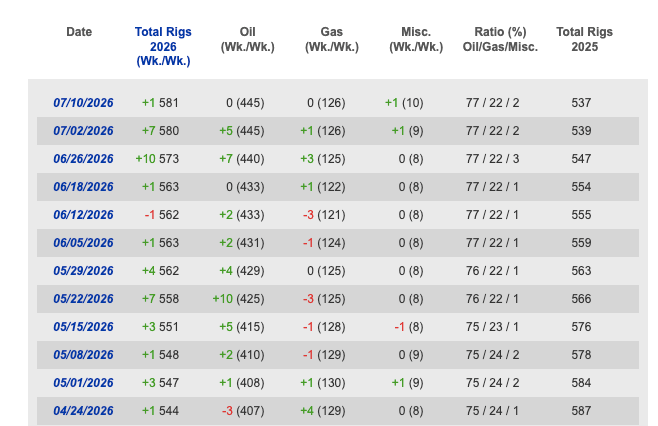
Rig activity has increased meaningfully over the past several months and shows no signs of slowing down. If this trend continues, it is likely EESE generates earnings much higher than the depressed numbers from 2024/2025.
2. Shareholder activism and board overhaul
In 2024, the company’s largest shareholder went activist and replaced the CEO and the entire board of directors.
Today, the three-person board represents the interests of the Melvin Smith Trust, which owns 24.6% of the company, and the Estate of George Shaw which owns another 5.5%.
The company’s largest owners now have direct oversight of management and are focused on improving shareholder value rather than maintaining the status quo.
Since taking control, the new board has focused on improving the quality of the business rather than the former strategy of pursuing growth at any cost. The clearest example of this shift was the 2025 sale of the company’s Patriot subsidiary.
Impact of Patriot sale
The Patriot business historically accounted for roughly 40% of EESE’s total revenue, but was also a lower quality business. The subsidiary primarily sold low-margin commodity chemicals and consistently generated the majority of the company’s losses. In contrast, the core Enduro-Tech business manufactures custom formulations and protective coatings, which generates higher margins.
The sale also allowed investors to view the financials of the core business for the first time. Enduro-Tech generated a net profit in both 2024 and 2025 despite operating in one of the weakest oilfield environments in recent years.
The improvement in business quality is also reflected in the company’s margins. Following the Patriot divestiture, gross margins increased from 50% to 64% in the most recent quarter. This suggests the remaining business has significantly better economics than the legacy company received credit for.
The sale also materially strengthened the balance sheet. EESE received cash proceeds from the transaction, while the buyer assumed debt associated with the Patriot business. Combined with additional debt repayments during 2025, net debt declined by more than 40% from $3.2 million to $1.8 million.
Valuation
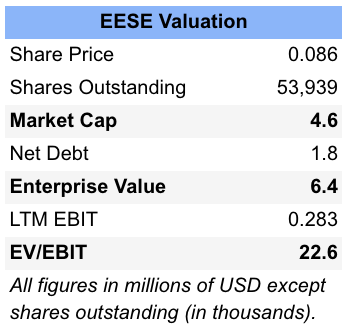
The company does not appear cheap based on trailing financials, but I think that is a big part of why the setup exists. The market appears to be valuing the company based on depressed earnings from the legacy business rather that the normalized earnings potential of the remaining segment.
During the favorable oilfield environment in 2022 EESE generated roughly $1.7 million of EBIT. If the company returns to a similar level of profitability the current price implies a valuation of 3.5x EV/EBIT.
I do not think it is required for EESE to achieve record results or meet the levels of profit generated in 2022 for this to work. Today’s business is smaller and generates less revenue, but is higher quality, with higher gross margins and a much stronger balance sheet.
I think the reason this company has flown under the radar is because the business transformation is not reflected in the trailing financials. From 2022 to 2025, revenue declined 55% and profitability fell off a cliff. In addition the Patriot sale resulted in a large non-cash accounting loss, which showed up as a net loss of $1.2 million in 2025. This understates the performance of the remaining business, which generated a net profit despite operating in a weak industry environment.
I believe the combination of an improved business profile, a stronger balance sheet, and a recovering oilfield environment creates the potential for materially higher earnings over the next several years that the market is not pricing in.
There is also potential upside in the event of a sale. Small energy service companies typically sell for 6-8x EBITDA, which would imply roughly double of the current price based on trailing numbers. The recent actions of the large shareholders have demonstrated a focus on increasing shareholder value, and a strategic sale could be an attractive way to realize this value.
Risks
There are many clear risks with this company:
Cyclical industry exposure: EESE’s financial performance is highly dependent on oil prices and drilling activity, which are outside of management’s control. If upstream spending does not recover as expected, demand for the company’s products could remain depressed and the expected earnings recovery may not materialize.
History of inconsistent profitability: EESE has generated inconsistent profits and generates a net loss most years. While the Patriot divestiture improved the quality of the business, it is unclear if the company can generate sustainable profitability through a full cycle.
Management execution: The new board appears aligned with shareholders and has taken positive steps to improve the company. However, the activist-led board has only been in place for a short period, and there is limited evidence of its ability to allocate capital effectively.
Liquidity risk: Although the Patriot sale materially improved the balance sheet, EESE remains a small company with limited liquidity. The company has historically relied on receivables factoring to support working capital needs, which could become a constraint during periods of weaker operating performance.
Microcap risk: EESE is a highly illiquid company with a $4 million market cap. Limited trading volume can make it difficult to establish or exit a position without impacting the share price, and the stock may experience significant volatility unrelated to changes in the underlying business.
Conclusion
I believe the company today is materially better than the one reflected in its historical financials. The combination of a higher-quality business, shareholder-aligned leadership, and improving industry conditions creates an asymmetric setup that the market has yet to recognize.
Disclosure: Long shares of EESE
Disclaimer: The information provided in this article is for informational purposes only and should not be considered investment advice. Investing involves risk, including the potential loss of principal. The author may own, or plan to purchase, shares in the security discussed. The author is not a registered investment advisor and does not provide personalized investment advice. Always conduct your own research and consider your investment objectives and risk tolerance before making any investment decisions. The author and publisher shall not be liable for any actions taken based on the information provided in this article.
Do you know what happened in Q1 2026? I spotted decline in continuing-operations revenue from $2.335 million in Q1 2025 to $902,300 in Q1 2026. And my main question is why?
1. Did EESE lose, or experience a permanent material reduction in business from, any significant customer during or following Q1 2026?
2. Was the Q1 decline primarily caused by shipment timing, delayed customer orders or temporary industry conditions?
3. Were material orders originally expected in Q1 subsequently shipped or recognized after March 31?